Author: marsadmin

  • What a Class A General Engineering Contractor Actually Does

    What a Class A General Engineering Contractor Actually Does

    Ask most people what a general contractor does and they’ll describe buildings — framing, finishes, tenant improvements. That’s the Class B world. The Class A license — General Engineering — covers a different job entirely: the heavy civil work that happens in the street, underground, and before any building can exist. It’s the license Mars Civil operates under, and it’s worth understanding what it actually authorizes.

    The work itself

    Class A covers fixed works that require specialized engineering knowledge and equipment: underground utility systems, sewer and water mains, storm drain, pipelines, earthwork and grading, concrete structures, and paving. In plain terms — if it’s buried, if it carries water or waste, or if a street has to be opened and put back to agency spec, it’s Class A work. Our crews self-perform it: trenching and excavation, pipe and structures, slurry backfill, and the concrete and asphalt restoration that closes the job.

    Why the license class matters

    Public agencies and most GCs don’t treat the license class as paperwork. Many public works scopes require a Class A prime or subcontractor outright, and the classification signals that the contractor is set up for the realities of civil work — agency inspection, compaction and materials testing, traffic control, prevailing wage and certified payroll, and bonding. A building contractor can be excellent at buildings and still be the wrong tool for a main replacement in a live street. The license is the first filter, and it’s there for a reason.

    What it means for your project

    For owners and GCs, working with a Class A contractor means one accountable firm from the first pothole to the final striping: we dig it, we build it, we backfill it to spec, and we restore the surface so the street looks like we were never there. With years of experience in Southern California streets, soils, and agency requirements — and our own crews and equipment — that’s the standard we bid to, whether the plans come from a city, a developer, or another contractor’s plan room.

    Have plans? Get a number.

    Bid requests, plan sets, and project questions — send them over and we’ll respond fast. Call us at 714.746.7611.
  • Slurry Backfill: Why Cities Spec It for Street Trenches

    Slurry Backfill: Why Cities Spec It for Street Trenches

    Every driver knows the trench dip — that sunken stripe across a lane where a utility trench was dug, filled, and paved, and then settled a few inches over the following year. It’s the most common failure in street utility work, and it’s exactly what slurry backfill exists to prevent. That’s why city after city across Southern California specs it for trenches in the public right-of-way.

    What slurry backfill is

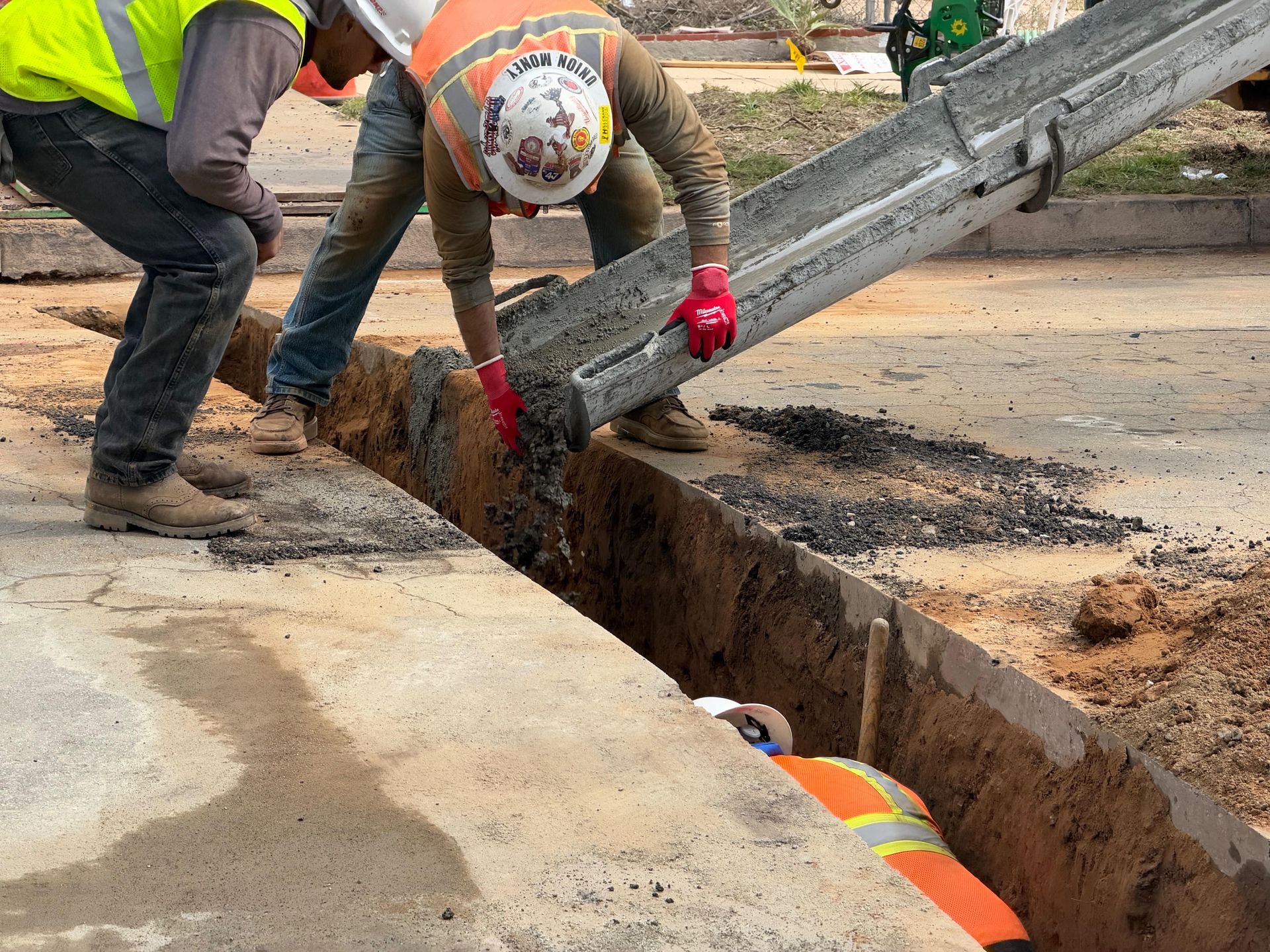
    Slurry backfill — formally controlled low-strength material, or CLSM — is a flowable, self-compacting fill placed in the trench as a liquid and allowed to set. It flows around the pipe and into every void that mechanical compaction can’t reach, then hardens to a strength engineered for the job: strong enough to support the pavement section and traffic loads, but still excavatable with conventional equipment if the utility ever has to be reached again. Think of it as the middle ground between loose soil and structural concrete.

    Why agencies spec it

    Three reasons come up on nearly every city standard. First, settlement: because slurry fills completely and doesn’t rely on lift-by-lift compaction, there’s nothing left to consolidate later — no dip, no callback, no re-paving at the contractor’s expense. Second, schedule: there’s no waiting on compaction test results between lifts, so the trench closes, cures, and gets paved on a predictable timeline, which matters when a lane closure is costing everyone patience. Third, consistency: the mix arrives with known properties from the plant, trench after trench, instead of depending on whatever native soil came out of the ground and how well each lift happened to be compacted.

    What to ask your contractor

    If your plans call for slurry, ask two questions. Does the contractor place it as a standard part of their own trenching operation, or is it an afterthought handed off and marked up? And do they know your agency’s specific mix and strength requirements — because they vary, and placing the wrong mix can mean tearing out and redoing the work at inspection. At Mars Civil, slurry placement is built into how we run street trenches: dug, piped, inspected, slurried, and restored by our own crews, to the governing agency’s spec.

    Have plans? Get a number.

    Bid requests, plan sets, and project questions — send them over and we’ll respond fast. Call us at 714.746.7611.